












.jpg)
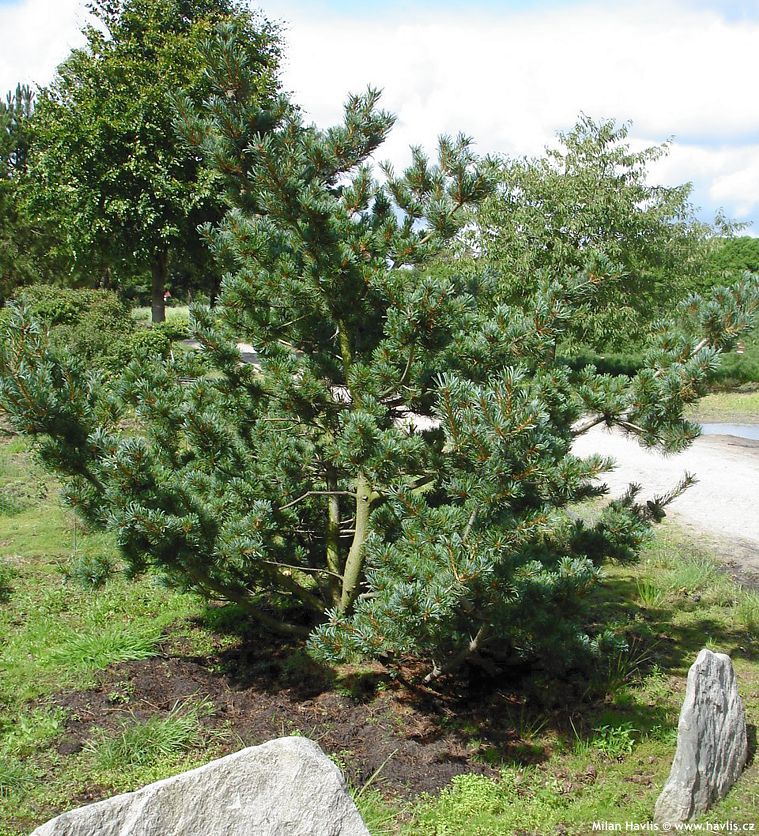

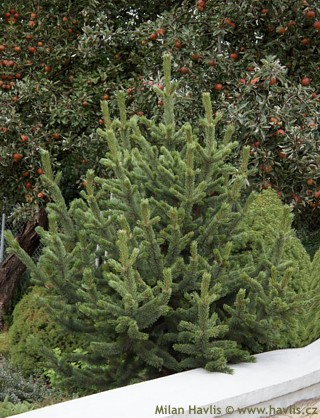
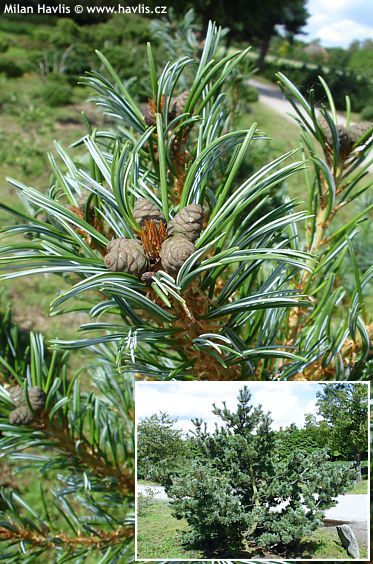
Pinus parviflora 'GLAUCA' Japanese white pine

 Ectovit (ectomycorrhizal)
Pinus
Pines are magnificent trees found across a wide range of climates – from the cold northern regions to the sun-scorched coastal plains: the Scots pine (Pinus sylvestris) withstands frosts down to around –50 °C and grows beyond the Arctic Circle, while the Aleppo pine (Pinus halepensis) tolerates summer heat exceeding +45 °C on the dry Mediterranean slopes. The genus Pinus is the largest genus of conifers in the Northern Hemisphere, comprising around 115 species. Fossil records show that it evolved as early as the Early Cretaceous, 130–140 million years ago. Botanists today divide it into two subgenera: subgenus Pinus, the so‑called “hard pines” with two to three needles per fascicle and denser wood, and subgenus Strobus, the “soft pines” most often with five needles per fascicle and softer wood. Within these subgenera, further sections are distinguished according to cone and needle morphology. Pines have become symbols of resilience and longevity, appearing in mythology and art from China to Europe, and their diversity is so vast that it includes towering mountain giants as well as dwarf garden forms. Many cultivars have been bred, yet the most beautiful remain the wild pine forests, whose place and size were never dictated by human hands.
Japanese White Pine (Pinus parviflora Siebold & Zucc., 1842) is one of the most beautiful trees of Japanese flora. It grows on the mountain slopes of Honshu and Shikoku, often clinging to wind-swept rocks – that’s where it develops its characteristic, irregular shape. It belongs to the Strobus group of “soft pines” with five needles per bundle, delicate and silvery blue-green, shimmering like silk in sunlight. In Japan, it is considered a tree of aristocrats: since the Edo period, it has adorned the gardens of samurai residences and temples. It was first brought to Europe from Japan around 1846. Its silhouette became an icon of bonsai art – Pinus parviflora is the most used species for classic bonsai because it ages gracefully and creates dramatic trunk lines. In nature, it can reach up to 25 metres, yet even then retains an elegant, tiered habit. An interesting feature is that its cones open slowly and remain on the tree for several years, adding a decorative touch to the canopy. In traditional ukiyo-e woodblock prints, it appears as a symbol of calm and perseverance, often contrasted with mountains and water surfaces.
The cultivar Glauca of Japanese white pine captivates with its elegance and strength. Its needles are 5–7 cm long, arranged in bundles of five, gently twisted, and display a silvery blue-green hue that shifts with light and season – appearing almost steel-blue in the morning sun, while at dusk they take on a soft bluish tone, warmer in summer and cooler in winter. Young trees have a dense, conical crown, but as they age, it broadens into a wide, tiered form with a flattened top, reminiscent of mountain landscapes depicted in Japanese paintings. Branches spread horizontally, creating a natural, picturesque structure. The bark is gray-brown, becoming scaly on older trees, adding character and a sense of age. This is a slow-growing form of the species, adding only about 10–12 cm per year; in garden settings it reaches 3–5 meters in height and 4–6 meters in width, while in its native habitat it can achieve nearly twice that size under ideal growing conditions.
Although the European name ‘Glauca’ appeared only in 1909, when Ludwig Beissner formally described it, bluish forms of Japanese white pine have been cultivated in Japan for centuries. Historical Japanese sources, such as gardening manuals from the Edo period (1603–1868), mention the cultivation of “goyōmatsu” (五葉松 – five-needle pine) as a fundamental element of tea gardens (roji) and dry gardens (kare-sansui, 枯山水) in Zen temples, where they symbolized tranquility, strength, and longevity. These trees embodied the philosophy of wabi-sabi—the beauty of imperfection and transience—and became living components of meditation. The relationship between people and the tree was profound: the pine was not merely decoration but a partner in the pursuit of harmony. ‘Glauca’, just like the species, has long been part of the so-called “big three” traditional bonsai species (alongside Japanese black pine and Japanese maple). Some bonsai specimens of these forms are now over 300 years old and are considered national treasures of Japan. Their bluish tones contrast with white gravel, dark stones, and moss, creating compositions that embody the principles of ma (the value of empty space) and wabi-sabi. This tree is a symbol of patience and respect for nature—it grows slowly but rewards with beauty that deepens over time.
Last update 07-02-2009; 14-07-2011; 23-11-2025
Japanese White Pine loves full sun and well-drained, slightly acidic soil. It cannot tolerate permanently wet sites, so in heavy soils drainage is essential. In nature, it grows on mountain slopes, so it appreciates slightly sandy or gravelly ground. Fertilisation is not necessary, but in spring you can support it with an organic fertiliser low in nitrogen. Watering is needed only in the first year after planting; later it tolerates drought, though occasional watering prevents dieback of two- and three-year-old branches, which is normal for this species in poor soils. Pruning is not required – its slow growth maintains shape naturally – but you can gently shape it by shortening “candles” in spring or even train it into a true bonsai. In containers, it needs a light substrate and perfect drainage. It is fully hardy down to –34 °C, so it requires no winter protection in temperate climates (USDA zone 4).