













Abelia × grandiflora 'Conti' CONFETTI® glossy abelia


 Symbivit Tric (arbuscular)
 Symbivit (arbuscular)
Abelia
Abelias (Abelia) are a genus of deciduous or evergreen shrubs in the honeysuckle family (Caprifoliaceae). In the current botanical treatment, the genus comprises only six species native to China, Vietnam, Taiwan and the Ryukyu Islands of Japan. In the wild, they are found mainly along woodland edges, in shrubby habitats and on sunny mountain slopes with well-drained soils. Their characteristic features include small opposite leaves, gracefully arching branches and masses of tubular flowers that appear over an exceptionally long period, from summer well into autumn. Although the individual flowers are not large, their abundance and persistence make abelias among the most valuable late-flowering shrubs.
The genus was first described botanically in 1754 by the Dutch botanist Johannes Gronovius (1686–1762), but its name commemorates a different man: the British physician, naturalist and traveller Clarke Abel (1780–1826), who took part in a diplomatic mission to China in 1816. During the expedition, he assembled valuable botanical collections, including plants of abelias that were then unknown in Europe. His return journey, however, turned into a drama. The ship carrying the collections was wrecked and later attacked by pirates, resulting in the loss of most living specimens. Only those plants that Abel had entrusted before his departure to his friend Sir George Thomas Staunton (1781–1859) in Canton survived. Thanks to this foresight, abelias were not lost and could be preserved for science. The next chapter of their story was written in 1844 by the Scottish plant collector Robert Fortune (1812–1880), who introduced seeds and living plants from China to Europe. This opened the way for their wider cultivation and subsequent breeding, which eventually led to the creation of the best-known garden abelia of all, Abelia × grandiflora.
The greatest success was achieved at the Italian Rovelli Nursery on the shores of Lake Maggiore, where the hybrid Abelia × grandiflora was bred in 1886. It arose from a cross between A. chinensis and A. uniflora, inheriting the finest qualities of both parents. From the former it gained abundant flowering and a pleasant fragrance, while from the latter it acquired its elegant habit and refined growth character. The new hybrid soon surpassed its parents and became, without exaggeration, the most widely cultivated abelia in the world. Its exceptionally long flowering season and attractively coloured persistent sepals provide an ever-changing display from early summer until autumn, setting it apart from many shrubs that reach their peak for only a few weeks before fading into the background. Abelia × grandiflora quickly spread throughout Europe and North America. During the twentieth century, it became the foundation for numerous cultivars differing in size and in the colour of their foliage and flowers.
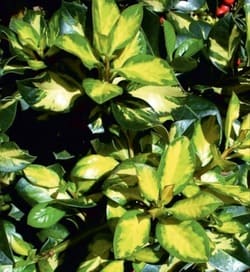
CONFETTI® glossy abelia wins you over with its tiny green-and-white leaves, which cover the plant so densely that they resemble a handful of confetti left behind after the party is over. The leaves are glossy, delicately pointed and mid-green, edged with an irregular creamy-white margin that often develops pink tones towards the end of the season, especially when the first cold autumn weather arrives. This colourful foliage is what truly sets the cultivar apart from most other abelias, because, truth be told, the flowers play only a supporting role here. They appear towards the end of summer and are small, tubular and white to pale pink. If autumn is long and warm, the floral display is followed by an encore in the form of salmon-pink to purple calyces that remain on the branches long after the flowers have faded.
CONFETTI® grows slowly into a dense, compact, cushion-shaped shrub, usually reaching around 50 cm in both height and width. Unlike most other abelias, it does not produce a fountain of long arching shoots, instead remaining neat and well-proportioned without the need for regular shaping. In milder winters it retains much of its foliage, which is an ornamental feature in its own right. During harsh winters the leaves may fall, only to be replaced by fresh new growth in spring. Its hardiness ranges from approximately -20 °C to -24 °C (USDA zone 6), depending on site conditions and exposure.
The cultivar was discovered by James T. Gwaltney in 1987 at Flowerwood Nursery in Mobile, Alabama, as a spontaneous mutation of the cultivar Sherwoodii. Under its registered name'Conti', it received U.S. plant patent protection in 1993, which expired in 2012. European protection remained in force until 2025.
Last update 06-01-2012; 05-11-2026
Glossy abelia thrives best in a sunny position and is happy in partial shade, too. In full sun, flowering is at its most abundant and the foliage develops its richest colouring, while in partial shade the shrub retains its elegant habit and flowers only slightly less freely. It performs well in ordinary garden soil, provided it is well drained and does not remain waterlogged for prolonged periods. Once established, it tolerates long periods of drought without difficulty. It withstands winter temperatures of approximately -25 to -29 °C and generally requires no winter protection. Only young plants may suffer some frost damage during exceptionally severe winters, but they usually recover well in spring. Pruning is not essential, although the plant responds well to it. Any pruning is best carried out in spring after the risk of severe frosts has passed. Smaller cultivars require only light shaping, while larger ones benefit from the occasional removal of the oldest or overly long shoots to maintain a dense, compact framework. Feeding is not needed and, in fertile soils, excessive fertilisation may encourage vigorous shoot growth at the expense of flowering. Glossy abelia's greatest virtues are its ease of cultivation, exceptionally long flowering period and ability to provide interest in the garden for many months with minimal maintenance.