











.jpg)


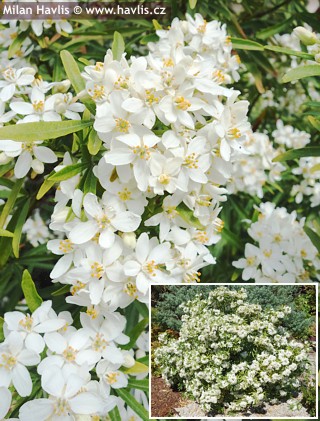
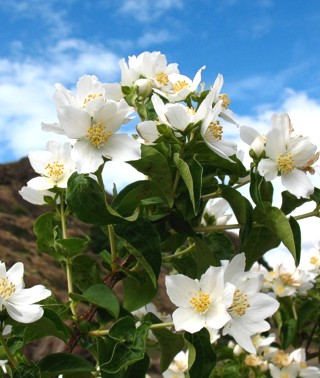
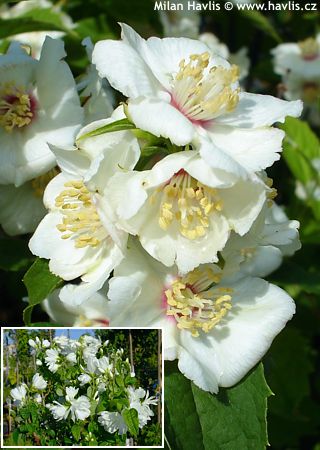
Philadelphus 'LEMOINEI' Lemoine's mock orange

 Symbivit Tric (arbuscular)
 Symbivit (arbuscular)
Philadelphus
The genus Philadelphus comprises around sixty species of deciduous shrubs in the hydrangea family. They are native to North and Central America and to East Asia, where they grow on slopes, in thickets and along streams. They reached Europe as early as the 16th century and quickly became popular for their snow‑white blossoms and intoxicating fragrance reminiscent of orange blossom. The botanical name refers either to the Greek word philadelphos – “loving brother” – or to the Egyptian king Ptolemy II Philadelphus. In the 18th and 19th centuries they became an inseparable part of castle parks and bourgeois gardens. The common English name mock orange refers to this very fragrance, which closely resembles that of true orange trees (Citrus aurantium), even though the plants are not related.
The hybrid Lemoine mock orange, or formerly Philadelphus × lemoinei, was created in Nancy, France, in 1884 by the breeder Victor Lemoine. He crossed the common mock orange (P. coronarius) from southern Europe and the Caucasus with the littleleaf mock orange (P. microphyllus) native to the southwestern United States. The result was a shrub that retained the abundant flowering and fragrance of the first parent but inherited the more compact growth and finer branching of the second. This hybrid became the foundation of an entire group of Lemoine mock oranges, many of which are still cultivated today.
Lemoine’s mock orange is most striking for its fragrance – sweet and jasmine‑like, filling the whole garden, though not as overpowering as that of P. coronarius. The flowers have four white petals, 2–3 cm across, arranged in terminal clusters of three to seven. Flowering begins in the first ten days of June and is among the most profuse in the genus. The shrub develops an upright to arching habit with age and usually reaches 1.5 to 2 metres, sometimes a little more in favourable conditions. The leaves are deciduous, small, ovate, smooth above and softly hairy beneath. Compared with P. coronarius it appears gentler and more delicate, which makes it suitable even for smaller gardens.
In the landscape, Lemoine’s mock orange works beautifully as a specimen shrub, where its abundant flowering can be fully appreciated, but also in informal hedges. It combines well with roses, lilacs or spiraeas, which bloom at the same time and complement its white cascade with colour. In parks it is often planted near paths and benches so that passers‑by can enjoy its fragrance. In smaller gardens it fits into mixed shrub borders, where its compact form prevents it from becoming overbearing.
Last update 27-06-2008; 02-11-2025
Cultivation is straightforward. It thrives best in full sun to partial shade, in well‑drained, moderately moist soil. It tolerates poorer conditions, though it suffers in heavy, waterlogged ground. It requires no fertilisation. After flowering it is advisable to prune – removing spent shoots and the oldest branches – to keep the shrub vigorous, fresh and floriferous. It is not poisonous or allergenic. Fully hardy down to −30 °C, it requires no winter protection.