












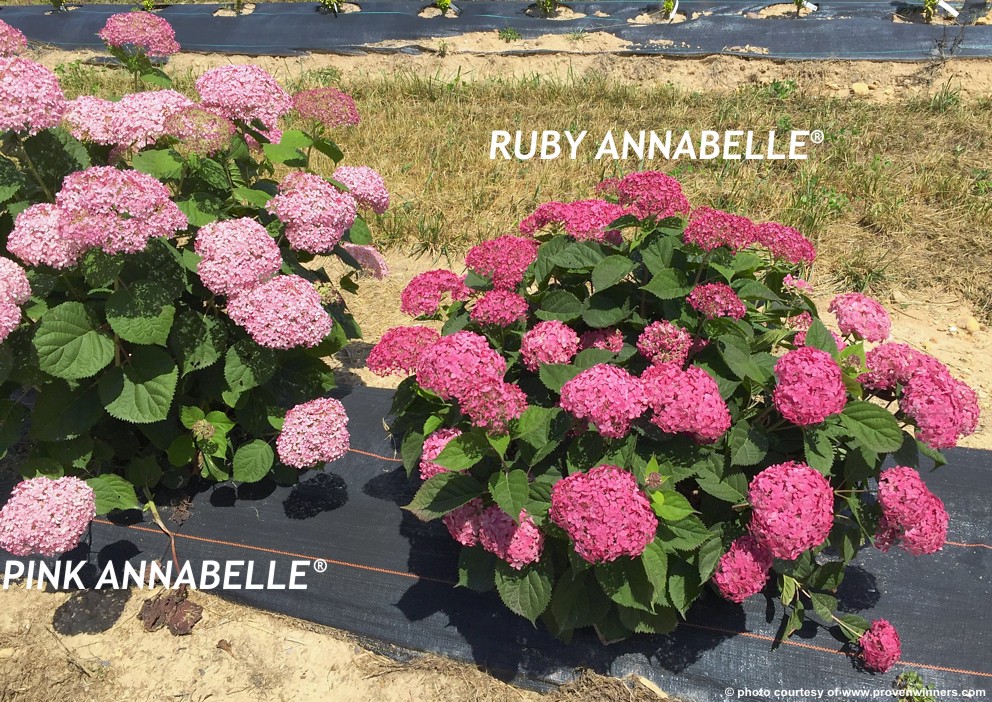
Hydrangea arborescens 'Ncha3' RUBY ANNABELLE® sevenbark, smooth hydrangea

 Symbivit Tric (arbuscular)
 Symbivit (arbuscular)
Hydrangea
The genus Hydrangea comprises about 70 species naturally occurring in Asia and North America. The greatest diversity is found in China and Japan, where hydrangeas have become part of cultural tradition and garden design. The first botanical descriptions date back to the 18th century, when European expeditions brought plants from Japan to botanical gardens in Paris and London. Fossil evidence shows that the genus is several million years old and evolved in the temperate zone of the Northern Hemisphere. Hydrangea arborescens, known as smooth hydrangea, originates from the eastern United States, growing in woodland edges and along streams. Carl Linnaeus described it botanically in 1753. In American culture, it is often planted near country houses and cemeteries, symbolising lasting memory and purity.
Breeding of this species has been carried out since 2006 by Dr Thomas Ranney at North Carolina State University. It all began in the Blue Ridge Mountains, where his student Rich Olsen discovered a rare pink-flowering Hydrangea arborescens, named Wesser Falls. Together they crossed it with the classic white ‘Annabelle’, and after five years, hundreds of trials and more than 1,500 tested plants, they selected a colour-stable and attractive cultivar. In the United States it was introduced as Invincibelle Spirit, while in Europe it became known as Pink Annabelle. Released in 2010, it quickly became not only a horticultural hit but also a symbol of hope – one dollar from each plant sold was donated to breast cancer research. By 2015, when the improved Invincibelle Spirit II was introduced, more than one million dollars had been raised. Other colours and smaller forms followed, such as Ruby Annabelle and Sweet Annabelle.
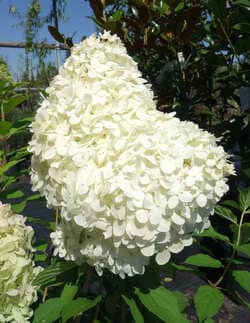
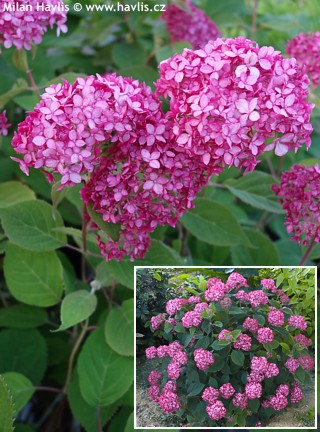
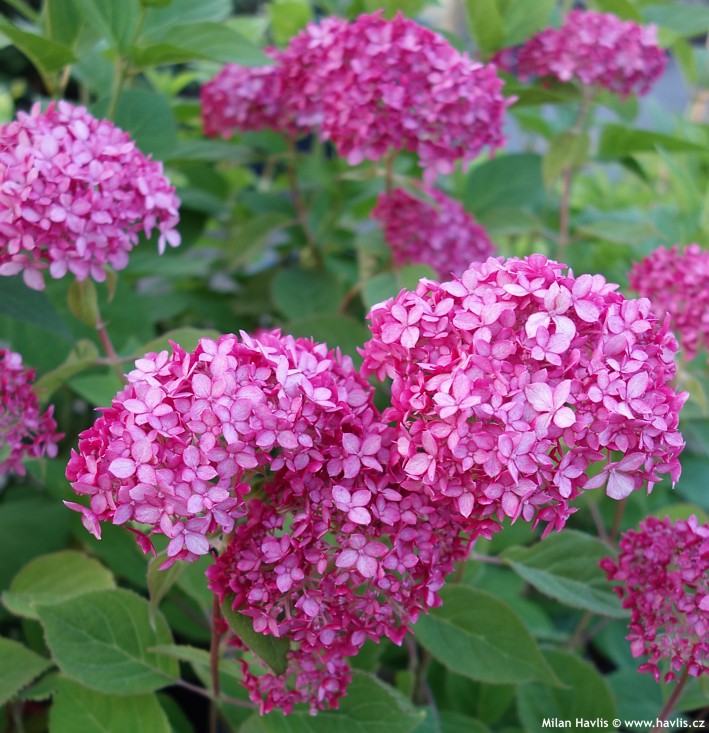
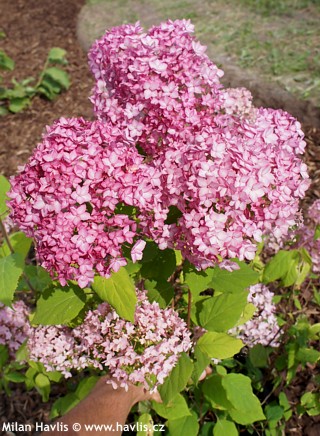
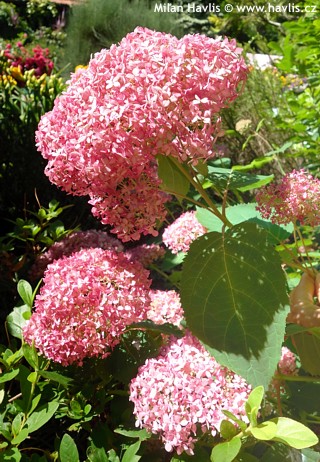
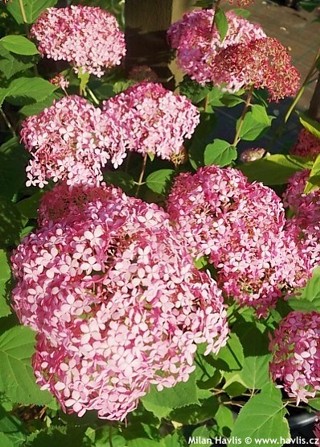
Ruby Annabelle is the second sensation among smooth hydrangeas with pink flowers. It produces spherical flower heads 12–17 cm in diameter, composed of rich pink to purplish-pink florets that gradually deepen into richer ruby shades. It usually begins flowering in mid-June and the blooms remain attractive until the end of July; after rain they generally do not need staking thanks to their firm and relatively short stems. Even afterwards they stay decorative, as their colour shifts into greenish tones and they dry only at the end of summer. Over time it is capable of a natural second flush, though it takes a while. You can speed this up with a simple trick – cut back the whole shrub after the main flowering, feed it generously, and new shoots will grow with fresh blooms that brighten gardens from late summer into mid-autumn.
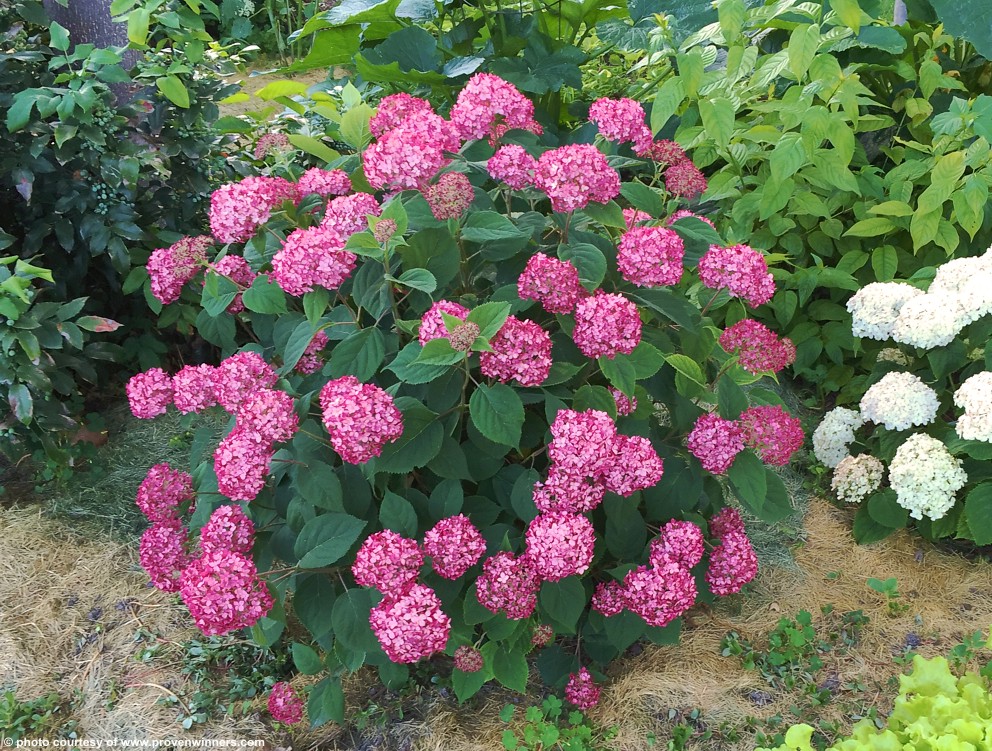
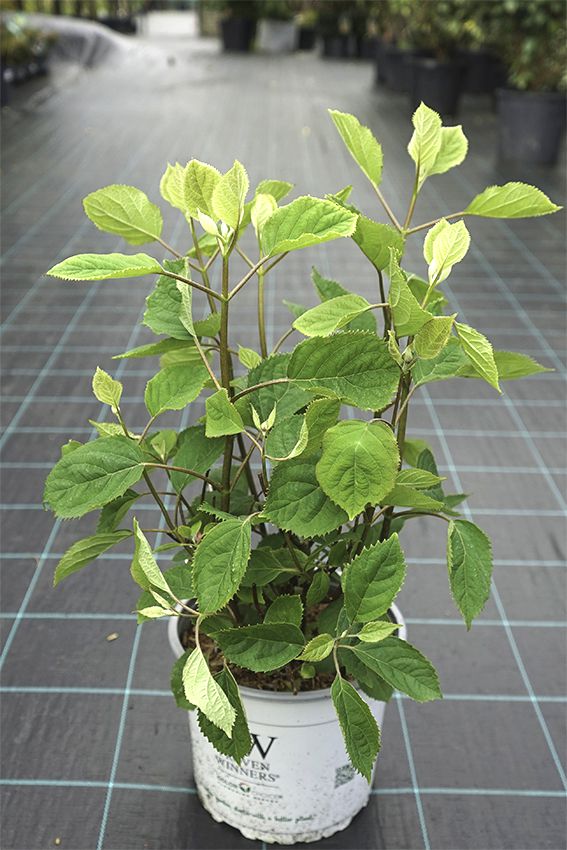
The leaves are deciduous, broadly ovate to elliptic, with finely serrated margins. They reach about 10–15 cm in length and 6–10 cm in width, giving the shrub a robust look and filling it well. In spring and summer they are bright green, contrasting beautifully with the ruby flower heads, and in autumn they turn yellow. The plant usually grows only around 70 cm tall, and under ideal conditions up to 1.2 metres in height and width, forming a compact, dense shrub with firm stems that hold the blooms well even after rain. US plant patent no. PP28,317 was granted in 2017.
A ruby-flowering hydrangea brings joy and service to any garden or front yard. Thanks to its compact size it fits well into smaller spaces, where it stands out beside dark-leaved shrubs or taller white-flowering perennials. It also contrasts beautifully with taller white panicle hydrangeas in the background, allowing striking two-tone groupings. It can be romantic or modern – everything depends on your combination.
Last update 05-02-2019; 17-11-2025
Cultivation of smooth hydrangea is straightforward. It thrives in full sun or light partial shade, with enough light to prevent stems from stretching. It tolerates full exposure if watered regularly during dry periods – complete drought is not tolerated as leaves wilt, turn brown and flower heads shrink. Watering is especially important during bud formation. It can withstand short-term waterlogging, but permanently saturated soil is harmful. The soil should be deep, humus-rich and well-drained, and of any pH. Mulching is recommended to keep the soil cool and moist and to protect the roots. Feeding is not essential, but the shrub can be supported after leaf emergence, and again before flowering with a balanced fertiliser low in nitrogen, ideally organic. Pruning is a must here, either in early spring or before winter in mild regions. Since it flowers on new wood, it benefits from deep rejuvenation – cut back up to 80% of the previous year’s growth. It can be grown in containers with regular watering and feeding but performs better in borders. It is neither poisonous nor allergenic and withstands frosts down to –34 °C (USDA zone 4); some sources even report successful cultivation in USDA zone 3, equivalent to –40 °C.

Goods are shipped all over Europe. For Russia and U.K. and for further details please read about SHIPPING OPTIONS HERE.
Are you interested in a serious discount for orders NOV-FEB? Check your options here.
THE PRICES INCLUDE VAT of 15%. For quick conversion you can use 1 CZK = approx. 0.04 EUR
- STANDARD QUALITY - Plants of this group are 1st class quality with number of branches and overall density adequate to their size and age, considering they were container grown.
- DE LUXE QUALITY - This label guarantees a luxurious quality of manually selected plants that, compared to their height and age, are exceptionally dense and beautiful.
- EXTRA - These plants are usually mature and bigger specimens with exceptional overall appearance.
- STANDARD (as described in the plant form) means a tree with a trunk of 190-210 cm and a crown at the top, unless specified differently. The commercial size for trees is their girth measured in the height of 1m from ground.
- HOBBY - These plants are of the same quality as our standard-quality plants but younger and therefore cheaper.
- SHRUB - a woody plant with branches growing bushy from the ground level.
- HALF-STANDARD or MINI-STANDARD - a small tree with shorter trunk, its size is usually specified.
- FEATHERED - These are trees with branches growing already from the base of the trunk and up along the stem.
- GRASSES and PERENNIALS - Sizes given usually read the diameter of the pot or the clump, as specified.
