




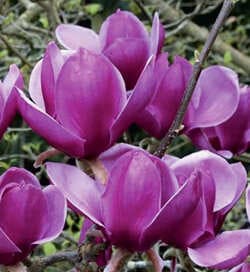






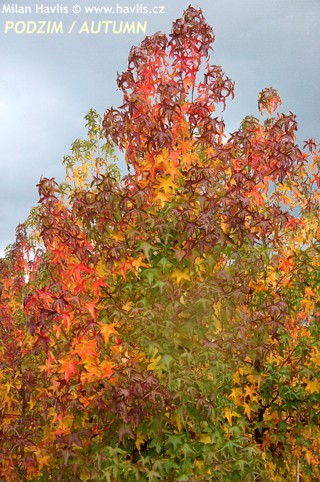
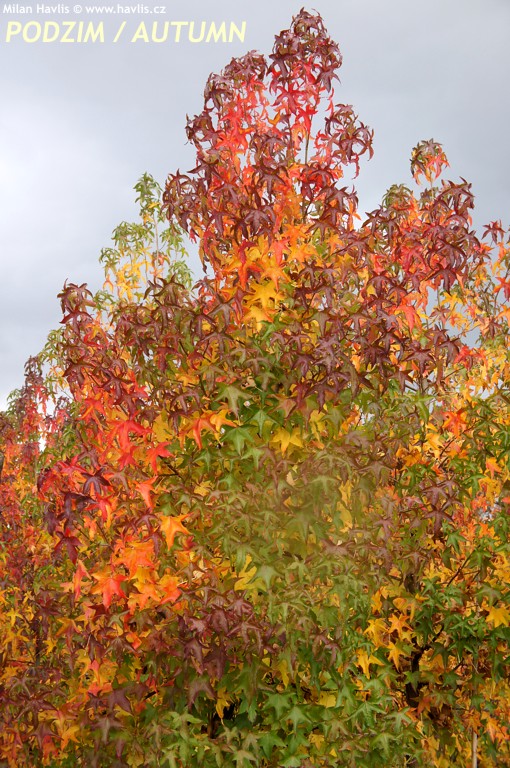
Liquidambar styraciflua 'SAFRO' sweetgum

 Symbivit Tric (arbuscular)
 Symbivit (arbuscular)
Liquidambar
The genus Liquidambar includes approximately 15 species of deciduous trees naturally found in the temperate zones of North America, Central America, and Southeast Asia. The best-known species, the American sweetgum (Liquidambar styraciflua), originates from the southeastern United States, where it forms part of mixed deciduous forests. The genus was formally described by Carl Linnaeus in 1753, but the first European record of sweetgum dates back to 1615, when Spanish physician and naturalist Francisco Hernández documented it during his expedition to New Spain (Virreinato de Nueva España), a vast colonial territory of the Spanish Empire in North and Central America with its capital in Ciudad de México (present-day Mexico City). He described it as a tall tree with aromatic resin resembling liquid amber – hence the genus name liquidambar. Although fossil evidence confirms the presence of sweetgums in Europe as early as the Tertiary period, today they occur here only as introduced ornamental trees.
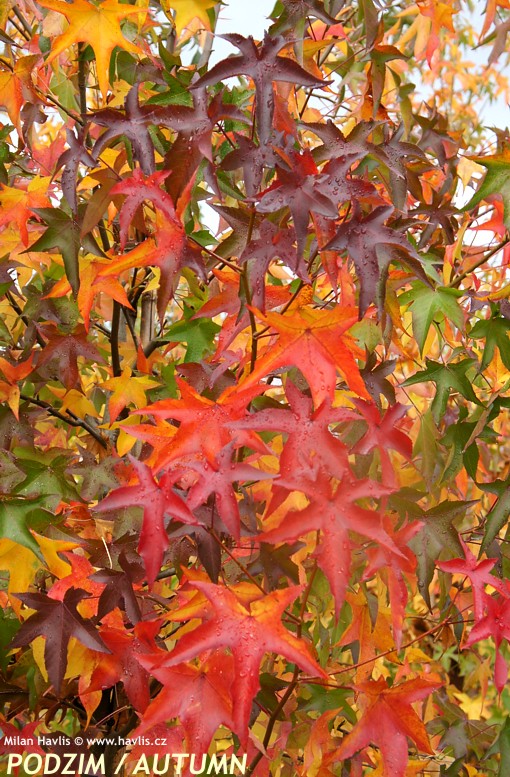
Sweetgums are often mistaken for maples by laypeople due to their similarly shaped, deeply lobed, palmate leaves, most commonly with five tips. What you definitely won’t confuse, however, is their scent when crushed – thanks to the tree’s signature aromatic resin, which is not only fragrant but also slightly sweet. Indigenous peoples of North America – such as the Cherokee and Choctaw – collected the resin, let it harden, and chewed it as a natural treat. Its somewhat sweet taste is what gave the tree its English name sweetgum. And when it comes to autumn foliage, sweetgums are clear winners, offering a wide range of vivid colours and holding onto their leaves longer than most other deciduous trees. In regions like New England or the Appalachian Mountains, they are among the main attractions of so-called "leaf peeping" – autumn trips to places with plentiful of autumn-coloured trees, now often organized by travel agencies. It’s the American counterpart to Japan’s momijigari tradition – just with hamburgers instead of jasmine rice.
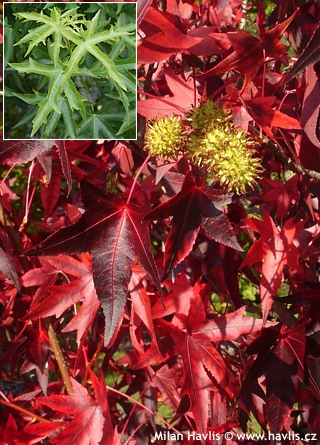
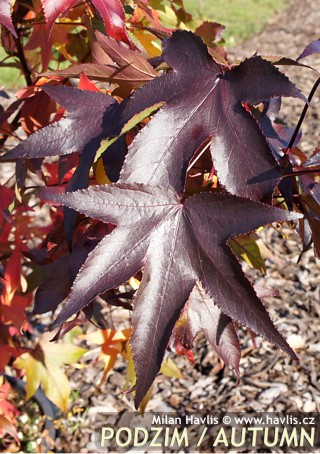
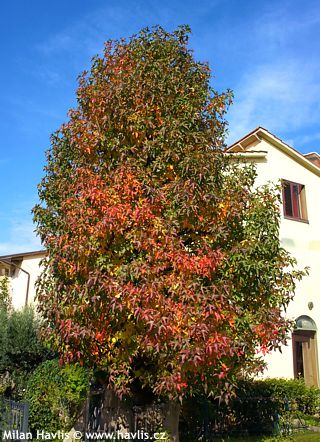
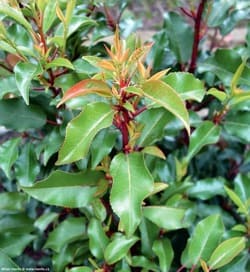
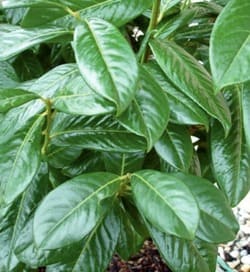
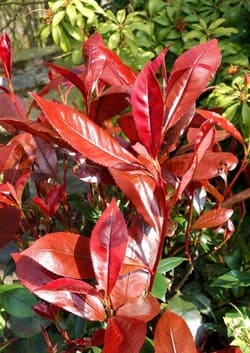
We are happy to present our selection of a sweetgum that was gained in Italian nurseries. It bears our name SAFRO®and we believe that you will find it as attractive as we do. It is a deciduous tree that has larger leaves than the species. They are deeply lobed, fresh green, and glossy, and offer a fantastic colour show in the autumn when they change to the following colours: golden-orange, scarlet red and deep purple and burgundy red. And what is most interesting – all at the same time on one tree. Coloured leaves remain on the tree for a considerable period of time. On well established plants they persist into December.
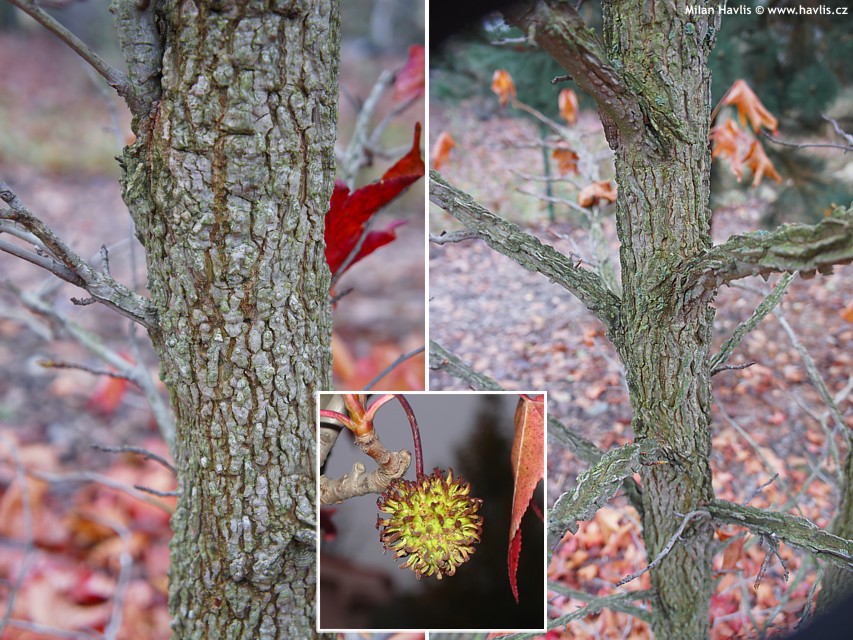
Unlike other large-leaved varieties with deeply lobed leaves Safro sweet gum keeps its typical feature which is fissured, corky bark on the trunk and branches. It grows medium fast into a tree with oval crown when young, and pyramidal shape later. This tree is easy to shape and can be kept smaller by pruning at the end of winter. Once you give it a desired form it does not usually go wild to spoil it for a long time. Another nice feature is the fruit. Formed in about 3 cm wide spiny spheres they can be quite attractive to look at and a bit irritating when stepped on barefoot once they have hardened up, if not cleared from pavements or lawns in spring.
Last update 19-11-2011
Sweet gums are soil tolerant but prefer semi-fertile, deep, evenly moist but well-drained soil that should be acidic or at least neutral. It will not thrive on chalk or lime. Once established they can take both temporary flooding and drought. The more acidic and moist soil you can provide (by adding peat and mulching the roots with bark) the better autumn colours can be expected. The location should be sunny as it does not tolerate shaded areas. If you buy a plant taller than say 1.5m stake it well for minimum of 2 or rather 3 years. Plants older than 3 years are fully hardy to about -27 °C (USDA zone 5) and can withstand short periods down to -29 °C.