










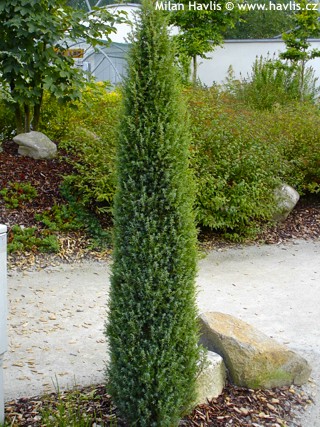
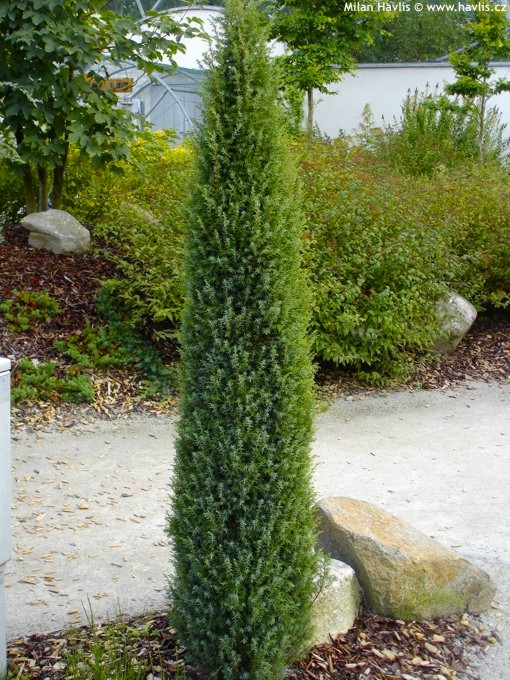
Juniperus communis 'ARNOLD' common juniper

 Symbivit Tric (arbuscular)
 Symbivit (arbuscular)
Juniperus
The genus Juniperus belongs among the oldest woody plants of the Northern Hemisphere, with a history reaching deep into the Tertiary period. Junipers shaped the landscape long before the first gardens were created, and their fossils have been found across Europe, Asia and North America. Besides Carl Linnaeus (1707–1778), who formally described the common juniper in 1753 and placed it within the botanical system, the genus was also studied by the Swiss botanist Albrecht von Haller (1708–1777). He paid close attention to the remarkable variability of woody plants, including junipers, in relation to altitude and climate, and pointed out that a single species may appear almost as several different plants across mountains, pastures and lowlands. Junipers thus became among the first woody plants that botanists struggled to fit neatly into a single category, and perhaps this is why they have retained a reputation for being somewhat wilful individualists to this day.
The common juniper is a native European species with an exceptionally wide ecological range. It grows from lowlands up to alpine zones, where it becomes a prostrate, wind‑sculpted shrub, while in open landscapes it forms upright silhouettes. For centuries it was part of everyday life – its wood scented rural houses, twigs were used to fumigate stables and dwellings, and the blue, glaucous cones ripening in their second year belonged both in the kitchen and in the medicine chest. Juniper still flavours game, rich and fat meats and spirits, the best known of which is gin. It is precisely the common juniper whose fruits are edible and safe to use; with other junipers one could not be so certain. In the landscape, juniper was regarded as a protective plant and a point of orientation. Today it is slowly disappearing from the wild, yet it is returning to gardens in the form of cultivars that transform its wild character into cultivated elegance.
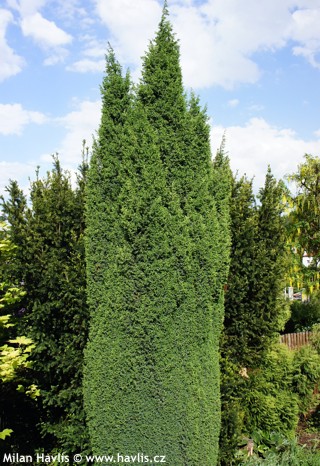
Arnold juniper is one of the most attractive columnar conifers. It is a slender evergreen shrub, narrower than the older cultivar ‘Compressa’ (1855, France) and growing more strongly upwards, which allows it to be incorporated into compositions of medium‑tall and taller plants rather than being confined to rock gardens, where ‘Compressa’ is more commonly used. The needles are fine, medium green above and white‑glaucous beneath, giving the whole plant a soft, gently green appearance without harsh contrasts. They are prickly to the touch, though less aggressive than other wild forms of common juniper, so the plant feels elegant rather than hostile. Growth is slow to moderate, around twenty centimetres per year, and the slender habit is maintained naturally without the need for pruning. Compared with typical forms of common juniper, ‘Arnold’ stands out for its firm, short branches that do not splay under the weight of snow, and for its naturally narrow habit, which it retains without cutting.
The cultivar was selected around 1950 in the nursery of Arnold Heeren in Jeddeloh, northern Germany, from where it was later introduced into cultivation. Credit for this exceptionally elegant form of common juniper belongs to Heeren, who combined the natural resilience of the species with an architectural silhouette reminiscent of Mediterranean cypresses. With the famous Arnold Schwarzenegger it shares only its name – do not expect muscles or poses – but the endurance and toughness most people associate with that name are certainly not lacking.
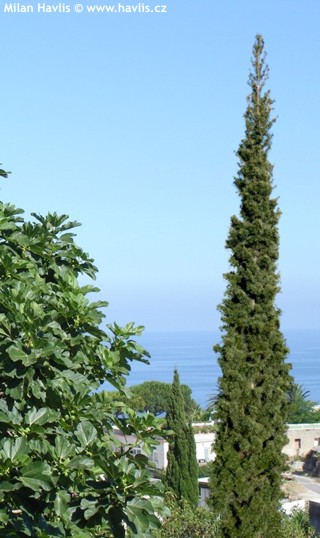
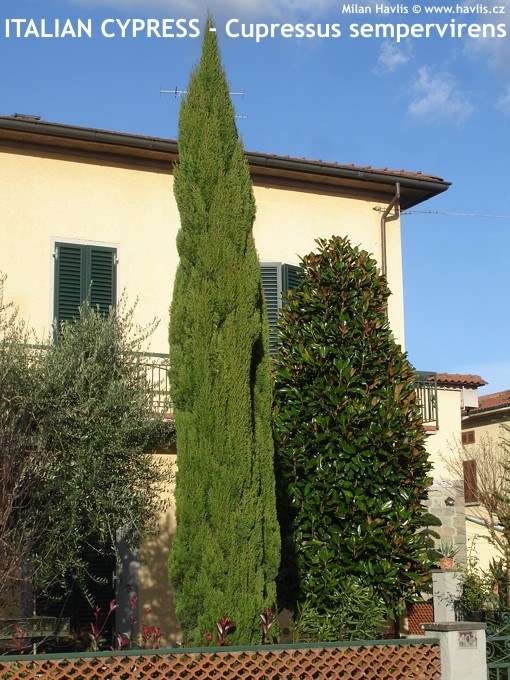
Thanks to its shape, ‘Arnold’ works superbly as a vertical accent in garden compositions. It can replace Italian cypresses in gardens inspired by Mediterranean style, where a truly hardy alternative is otherwise missing. It complements groups of spreading shrubs such as azaleas, boxwood or hebe, and also excels as a specimen plant at entrances, along paths or in narrow beds where there is no space for width. Its regular form has a calming effect and lends clear structure to a planting scheme. If it seems too strict, plant larger single‑species nests of loosely growing flowering perennials beside it. This will enliven the composition, and the contrast between the juniper’s slender firmness and the playful character of the perennials will be pleasing to the eye.
Last update 28-12-2010; 20-01-2026
Junipers are generally undemanding plants, and the common juniper as a species shares these modest requirements. It prefers a sunny position, where it maintains compact growth and good colour; in partial shade it may survive but loses density and character. It is not particular about soil type – it will grow in ordinary garden soil as well as in poorer, stony or sandy soils – but good drainage is essential, and permanently waterlogged sites should always be avoided. It tolerates drought very well and requires watering only after planting. Fertilisation is unnecessary, or at most very light. Pruning is not required for the plant’s survival and is carried out exceptionally, in cultivars that either grow rapidly or tend to spread (for example under the weight of snow), ideally in late winter. The common juniper is fully hardy and easily withstands temperatures down to around –40 °C (USDA zone 3).