













Morus + ODRŮDY edible mulberry

 Symbivit Tric (arbuscular)
 Symbivit (arbuscular)
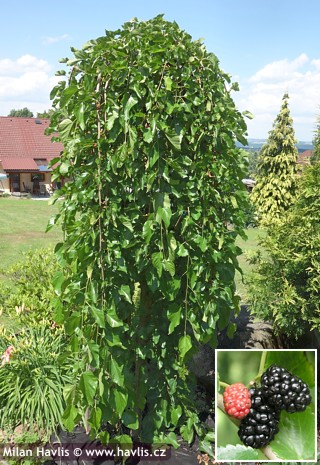
Mulberry is a versatile tree used in ornamental landscaping as well as pomiculture. You can find it in standard forms with a long trunk, or as a half-standard which is suitable for easy fruit picking. It can also be seen grown as a shrub densely branched from the ground. Here we will describe edible forms of morus nigra, morus rubra, morus macroura and their hybrids, plus morus alba except for its weeping variety Pendula which has its own description here.
Deciduous leaves are heart-shaped, toothed at margins, up to 15 cm long, deep green and glossy, changing yellow in autumn. Mulberry belongs to the same family as fig tree and its leaves sometimes show irregular lobes similar to fig leaves.
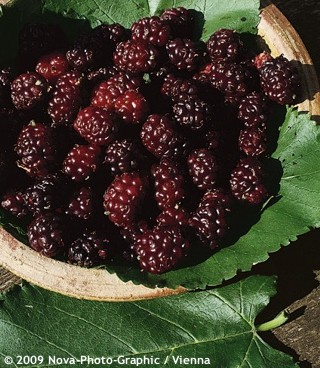
The fruit ripens from early to midsummer. It is oval to oblong, 2-5 cm long, black, and easy to pick when fully mature. That is why some growers lay a sheet beneath the tree so that the ripe fruit falls down on it and they can easily pick it up clean. It cannot be stored and must be eaten or processed immediately. Fresh fruit has a pleasant, sweet taste with a light acidic flavour. It is best eaten fresh or used in desserts, but can be canned or made into preserves, too. Mulberry is self-fertile = it does not need a pollinator.
VARIETIES
Jumbo (black mulberry) is a variety with large and chubby fruit of delicious taste.
Wellington (red mulberry hybrid) is a heavy cropper with excellent fruit.
An interesting thing is that the whole plant has high potential in medicinal usage, especially in Chinese medicine it has long history. Leaves are good for diseases like cold and bronchitis, fruit has a tonic effect on kidney energy and in the treatment of urinary problems as well as premature hair graying, and the root bark is found useful for curing asthma, hypertension, and even diabetes.
Last update 14-04-2010; 13-01-2017; 13-05-2018
Mulberry has been grown in our country for centuries and is widely adaptable. Though, for highest yields and plant health it needs a warm position and a lot of sun for plenty of fruit. Grow it in any well-drained soil, constant moisture will guarantee healthier foliage. Heavy clay and water-logged soil may result in root-rot and death of the plant. Prune it when young to achieve a desirable shape, it can also be sheared regularly at the end of winter to reduce its size in small gardens. Hardy to about -29°C (USDA zone 5).