









quick search

  • order
  • hardiness
  • heaven on earth
  • pictures

red oak

Quercus rubra (q.americana)

red oak

USUAL HEIGHT and WIDTH
15-20m x 10-15m
LEAVES
deciduous broadleaf
SIZE/TYPE
tall tree
COLOUR OF LEAVES

green
BLOOMING TIME
LOCATION
full sun
FLOWERS
insignificant or non-blooming
USDA zone (lowest)
3   (down to -40°C)
COLOUR OF FLOWERS

WINTER PROTECTION
for zone 5+6
Code of winter protection zone 5+6
for zone 7
Code of winter protection zone 7
Belongs to categories
Deciduous broadleaf
SIZE and PRICES
form container size size quality price (incl. VAT) where in stock sending options quantity
De Luxe
PRAGUE BY CAR
De Luxe
CHLUMEC BY CAR
NOT IN STOCK? WHY NOT TO TRY A SIMILAR ONE:
THE PRICES INCLUDE VAT of 10%. For quick conversion you can use 1 CZK = approx. 0.04 EUR


CLICK FOR MORE IMAGES


GLOSSARY

  • STANDARD QUALITY - Plants of this group are 1st class quality with number of branches and overall density adequate to their size and age, considering they were container grown.
  • DE LUXE QUALITY - This label guarantees a luxurious quality of manually selected plants that, compared to their height and age, are exceptionally dense and beautiful.
  • EXTRA - These plants are usually mature and bigger specimens with exceptional overall appearance.
  • STANDARD (as described in the plant form) means a tree with a trunk of 190-210 cm and a crown at the top, unless specified differently. The commercial size for trees is their girth measured in the height of 1m from ground.
  • SHRUB - a woody plant with branches growing bushy from the ground level.
  • HALF-STANDARD or MINI-STANDARD - a small tree with shorter trunk, its size is usually specified.
  • FEATHERED - These are trees with branches growing already from the base of the trunk and up along the stem.
  • GRASSES and PERENNIALS - Sizes given usually read the diameter of the pot or the clump, as specified.
DESCRIPTION
Oaks are common trees of our natural woodlands. They border our ponds, occur naturally in our mixed forests, and make magnificent specimen trees in our parks and arboretums where less common species or rare varieties can be seen.

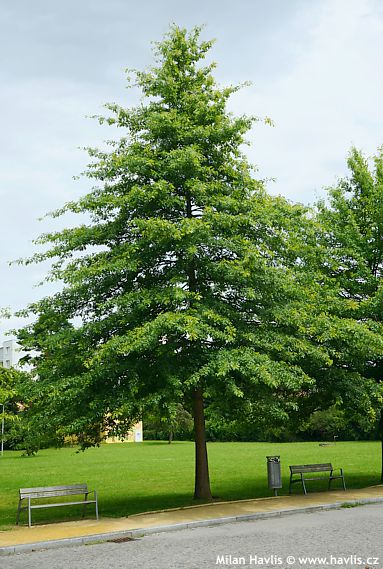
Red oak is also called American oak thanks to its origin in north-eastern USA and Canada, owing to which it is very cold hardy. And just like many other very hardy trees also this one gets considerably tall when adult. Red oak can grow up to 20 m, and even a bit more in large parks where it has enough space and nutrients.

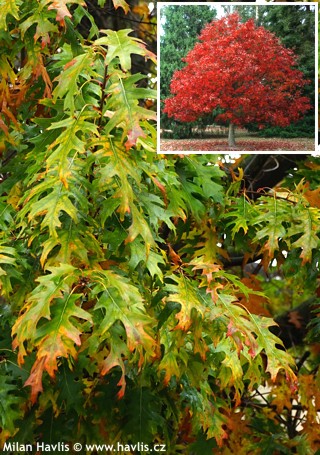
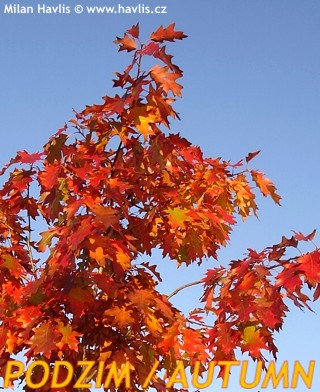
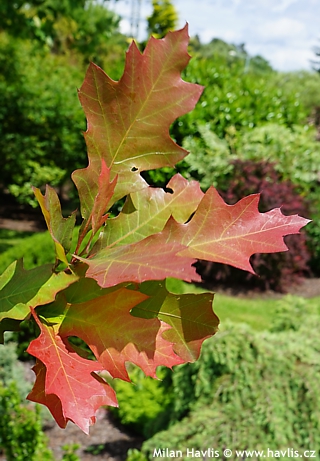
Deciduous leaves are rather big for an oak – up to 20 cm across, cut into bristle-tipped 7-11 lobes. They are deep green and glossy in the season, turning spectacular shades of golden orange, scarlet red and rouge in the autumn. The crown is pyramidal when young, changing to rounded with age when it offers a nice shade. Young trees should be trained into a leader and lateral branches spaced well apart along the trunk to form a strong framework.

Oaks are not fussy about soil type, but this one needs lime-free soil. They do well in well-drained soil, moist is good but boggy is fatal. Once established they withstand drought and city pollution. Newly planted trees need to be staked for 2-3 years to establish. Roots are strong and can heave pavements. Fully hardy to -40°C (USDA zone 3).

Last update 05-10-2010